Your Body, Your Data: A Practical Guide to At-Home Health Tests That Can Catch Problems Early
Not long ago, a blood pressure reading required a trip to a clinic, a glucose check demanded a laboratory order, and a urinary tract infection could only be confirmed after a physician visit. Today, each of those assessments can be performed on a kitchen counter before breakfast. The at-home health monitoring market in the United States has grown into a multi-billion dollar industry, fueled by advances in consumer-grade biosensors, a post-pandemic appetite for self-directed care, and an increasingly cost-conscious public looking to reduce unnecessary medical appointments.
Yet the proliferation of available tools has outpaced most consumers' understanding of how to use them well. A blood pressure cuff used with poor technique can produce readings that are misleading. A glucose meter calibrated for one testing strip brand may give inaccurate results with another. A positive result on a rapid antigen test carries a different statistical meaning than most people realize. Owning the right tools is only the beginning. Knowing how to interpret what those tools tell you — and when to stop interpreting and start calling your doctor — is what separates useful self-monitoring from false reassurance.
Blood Pressure Monitors: The Most Valuable Tool in Most Homes
Hypertension affects nearly half of all American adults, according to the Centers for Disease Control and Prevention, and a substantial portion of those individuals are unaware of their condition. Home blood pressure monitoring has robust clinical support as a complement to office-based care, with multiple cardiology guidelines recommending it for patients already diagnosed with hypertension as well as for those at elevated risk.
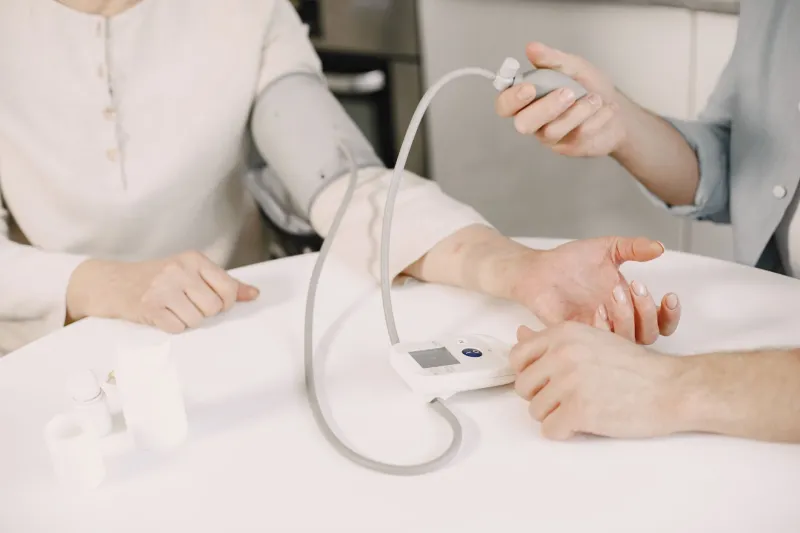
For home use, an upper-arm cuff oscillometric monitor — validated by an independent organization such as the American Medical Association's Blood Pressure Validated Device Listing — is consistently more reliable than wrist-based models, which are highly sensitive to positioning errors. When taking a reading, sit quietly for five minutes beforehand, keep your feet flat on the floor, support your arm at heart level, and avoid talking. Take two readings one minute apart and record the average.
One reading elevated above 130/80 mmHg is not cause for alarm. Blood pressure fluctuates throughout the day in response to activity, stress, caffeine, and even conversation. What matters is a pattern. Clinicians recommend logging readings at the same times daily — typically morning before medications and evening before bed — over a period of at least one to two weeks before drawing conclusions. A sustained pattern of elevated readings warrants a conversation with your healthcare provider, not a self-diagnosis.
Glucose Meters: Powerful Tools That Require Context
For the roughly 37 million Americans living with diabetes and the estimated 96 million with prediabetes, home glucose monitoring is a clinical necessity. For others, it has become an increasingly popular wellness practice. Consumer-grade continuous glucose monitors, once available only by prescription, are now sold over the counter through retailers including pharmacies and major online platforms.
Standard fingerstick glucose meters are accurate to within approximately 15 percent of laboratory values under FDA standards — adequate for tracking trends and managing known diabetes, but insufficient for diagnosing the condition. A fasting blood glucose reading above 126 mg/dL on two separate occasions, or a reading above 200 mg/dL with symptoms, requires laboratory confirmation and physician evaluation. Home meters should not be used to self-diagnose diabetes or prediabetes.
For those already managing diabetes, meter accuracy depends heavily on proper technique: clean, dry fingers; unexpired test strips stored correctly; and regular device calibration. Continuous glucose monitors offer the added value of trend data — showing not just where glucose is at a given moment, but whether it is rising or falling and how quickly — which can be meaningfully more informative than isolated fingerstick readings.
Rapid Tests for Infectious Illness: Understanding Sensitivity and Specificity
The COVID-19 pandemic introduced tens of millions of Americans to the concept of rapid antigen testing, and with it, the statistical concepts of sensitivity and specificity — even if those terms were never explicitly named. A test's sensitivity refers to its ability to correctly identify people who have a condition. Its specificity refers to its ability to correctly identify people who do not.
Rapid antigen tests for respiratory illnesses, including COVID-19 and influenza, tend to be highly specific — meaning a positive result is quite reliable — but less sensitive than laboratory PCR tests, meaning a negative result does not rule out infection, particularly early in the course of illness. This is why current guidance from the CDC recommends repeat testing if symptoms are present and an initial rapid test is negative.
Over-the-counter strep throat tests, UTI dipstick strips, and mononucleosis tests operate under similar principles. UTI dipstick tests, for example, detect the presence of nitrites and leukocyte esterase in urine — markers associated with bacterial infection — but can produce false negatives in early infection and false positives in cases of dehydration or certain dietary factors. A negative home UTI test in the presence of classic symptoms — burning, urgency, frequency — should not delay a physician consultation.
Thermometers, Pulse Oximeters, and the Tools Worth Having
A digital oral or temporal artery thermometer is among the most straightforward and reliable home health tools available. For adults and children over three months of age, oral or temporal readings are generally adequate for home monitoring. Rectal thermometry remains the most accurate method for infants under three months, for whom fever assessment is particularly consequential.
Pulse oximeters, which measure blood oxygen saturation and heart rate via a sensor clipped to the fingertip, became household staples during the COVID-19 pandemic. They are genuinely useful for individuals with known respiratory conditions such as asthma, COPD, or heart failure, and for monitoring recovery from respiratory illness. However, published research — including a widely cited 2022 study in the New England Journal of Medicine — has documented that pulse oximeters can overestimate oxygen saturation in individuals with darker skin tones, a limitation consumers should be aware of. A reading below 95 percent, or any reading accompanied by symptoms such as shortness of breath, confusion, or bluish discoloration of the lips, warrants immediate medical attention regardless of device type.
Pregnancy and Fertility Tests: High Reliability With Important Caveats
Over-the-counter pregnancy tests have become remarkably sensitive, with many detecting human chorionic gonadotropin at levels as low as 6.5 mIU/mL — low enough to produce a positive result several days before a missed period. A positive result on a home pregnancy test is highly reliable. A negative result taken very early in a potential pregnancy, however, may not reflect a true negative, and retesting after a missed period is advisable.
Home ovulation predictor kits, which detect the luteinizing hormone surge that precedes ovulation, are widely used in family planning and fertility tracking. They are most informative when used consistently across multiple cycles to identify individual hormonal patterns rather than relying on a single cycle's data.
Turning Data Into Dialogue With Your Doctor
The greatest value of home health monitoring is not the individual reading — it is the longitudinal record. A week of blood pressure logs, a month of glucose trends, or a pattern of low-grade fevers recurring on a predictable schedule provides your healthcare provider with context that a single office visit rarely captures.
Bring your data. Most smartphones can store health readings through native health apps or third-party platforms, and many modern home monitors connect directly to these systems via Bluetooth. A printed or digital log organized by date and time of day transforms a collection of numbers into a clinically useful narrative.
Know, too, when self-monitoring has reached its limit. Home tests and monitors are tools for observation, not diagnosis. They are most valuable when they inform timely, well-prepared conversations with healthcare professionals — not when they substitute for them. Used thoughtfully, they represent one of the most accessible and genuinely empowering developments in everyday American healthcare.